Case study
Scrap-car operations 報廢車收購管理系統
In production since July 2026
Every car, from the tow truck to the motor vehicles office, in one place.
An operations system for a small business in Taipei and New Taipei that buys end-of-life cars from dealerships and repair shops, tows them, handles the deregistration paperwork and sells them on. The owner also drives the tow truck, and an office assistant handles the motor vehicles office. Salespeople, drivers and the document courier do everything in LINE; the owner and the office use a web back office. We built both, and the backend behind them.
- We built
- LINE Official Account with menus and forms for each role, web back office, backend
- Used by
- Owner, office assistant, partner salespeople, drivers, document courier
- Release
- In production since July 2026, still shipping
- Area
- Taipei and New Taipei
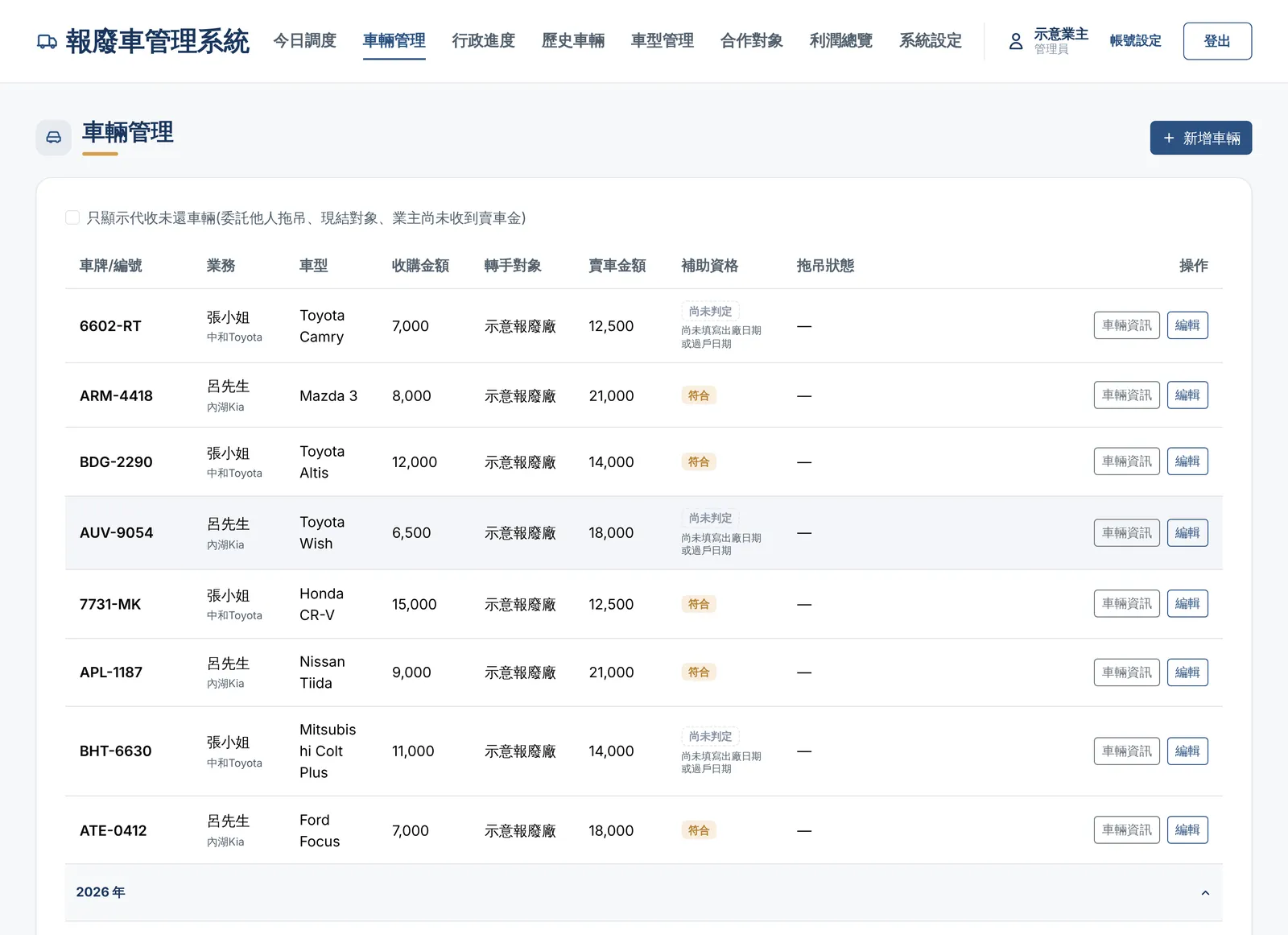
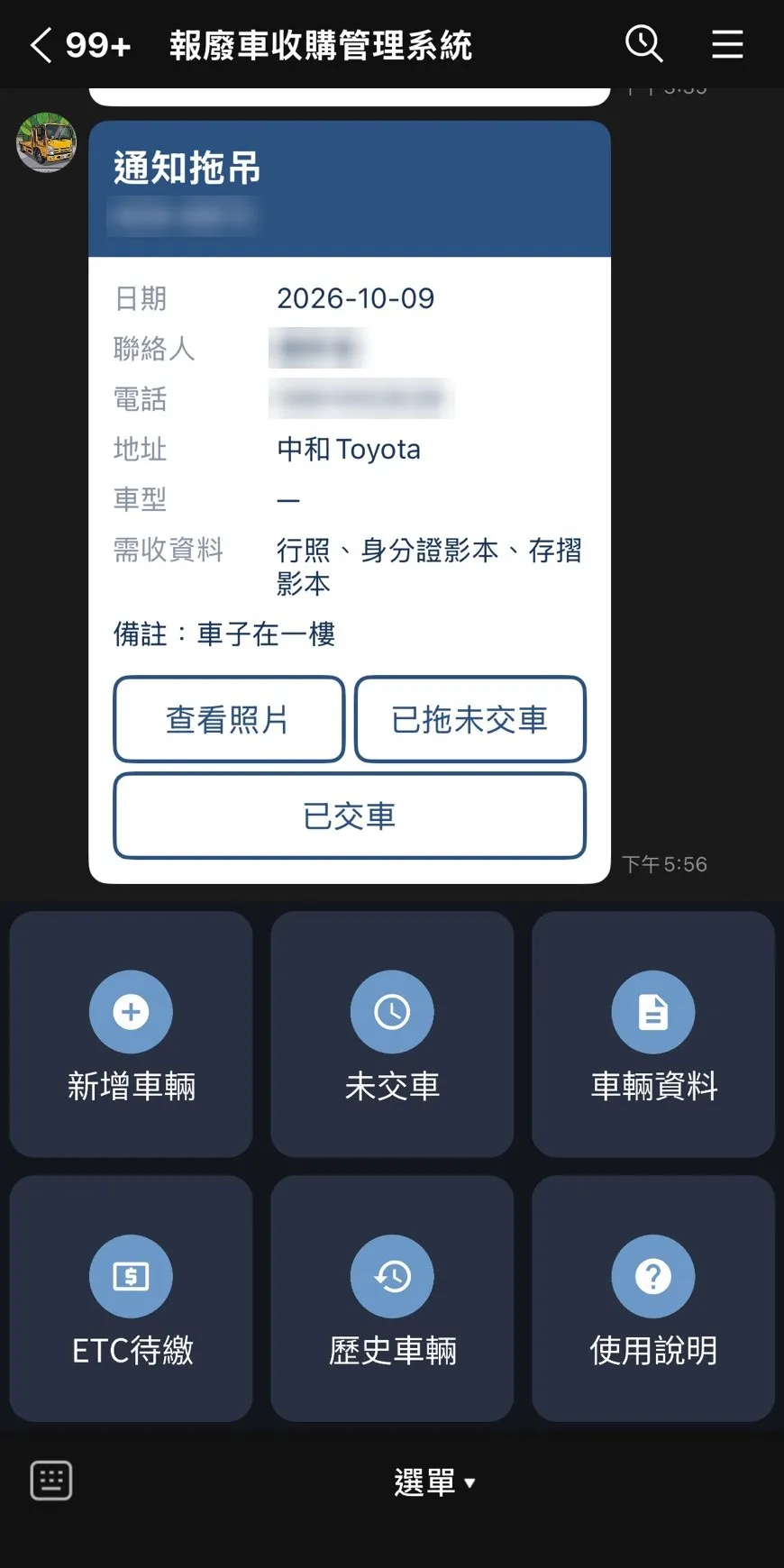
What changed for the business
-
Before
Same-day tows and bookings made two months ahead lived in the owner’s head and in LINE chats.
Now
One schedule. Bookings move onto the day’s list by themselves, with LINE reminders at 8 am and 9 pm.
-
Before
Each evening the owner tried to remember which cars had been collected that day, dug the photos out of LINE and forwarded them. Progress was tracked on paper.
Now
Salespeople and drivers send details and photos to the company’s LINE account, and they’re filed under the right car automatically.
-
Before
Whether a car qualified for the government trade-in subsidy was often only found out at the motor vehicles office.
Now
Eligibility is worked out from the car’s dates as soon as they’re entered.
-
Before
Cash deals, instalments and export sales were mixed together, and cash handed to the courier went unrecorded.
Now
Every car has its own profit line, partner payments are tracked, and each cash hand-off is followed in three steps.
How it works
-
LINE is the whole field app
Seven menus, one for each role. Salespeople book tows and add documents through forms inside LINE, drivers mark cars towed and delivered, the courier confirms hand-offs. The bot answers commands like 今日行程 (today’s tows) and understands everyday dates like “tomorrow” or “in five days”.
-
Booking the tow creates the car
Filling in a tow booking creates the vehicle record in the same step, so nothing is typed twice. Each car moves from awaiting tow to towed to delivered, and the day’s order can be dragged around as plans change.
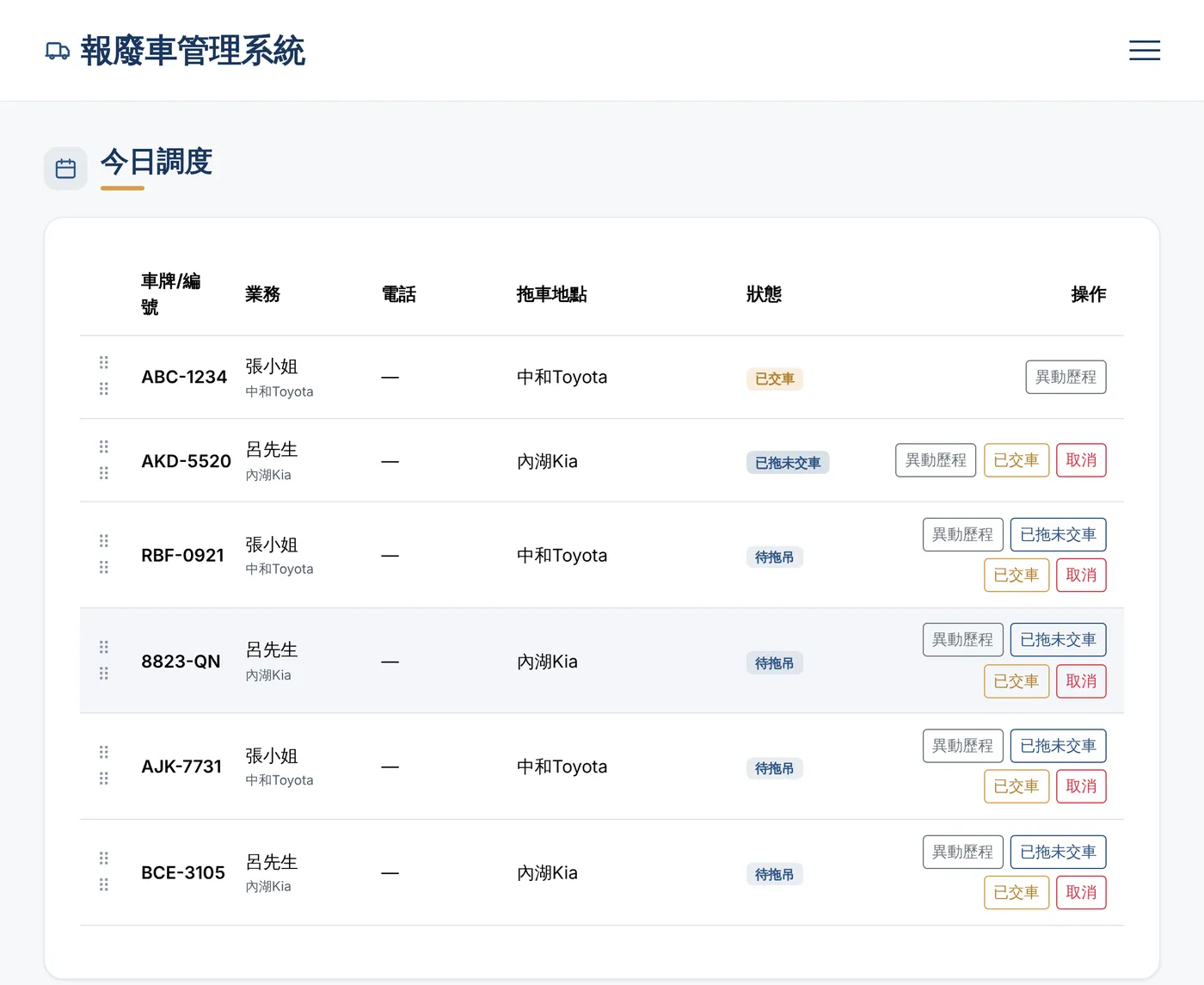
Real interface, sample data. -
Paperwork, car by car
Every car follows the same five stages, from collected through deregistration to the tax refund and the recycling reward. Stages can be skipped when the office works in batches, and the assistant can ask the right salesperson for a missing document in one tap.
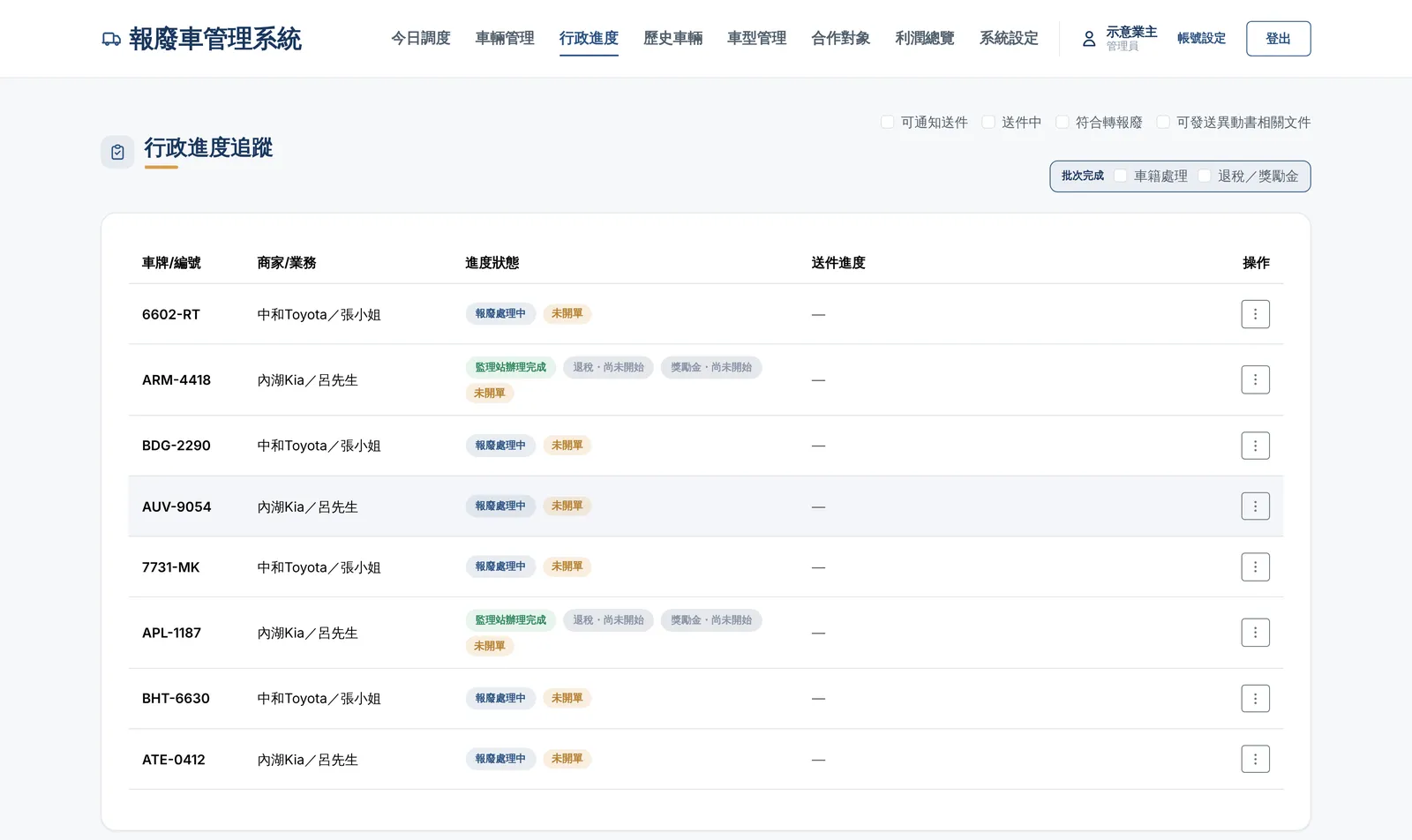
Real interface, sample data. -
Rules that used to live in the owner’s head
Subsidy eligibility (a car at least 10 years old, owned for at least a year) shows as eligible, not eligible or not yet known. Cars can be found by the digits on the plate alone, cars without plates get a short tracking number like T0001, and duplicate photos are caught automatically.
-
Profit, per car
Resale price minus purchase price, plate fee and driver fee, worked out for every car, with weekly and monthly totals and partner payments. The office assistant never sees resale prices or profit.
Built with the owner, one change at a time
We shipped in small slices, and the owner tried each one on their own phone. What they said decided what came next.
-
What the owner said
“Why type in the manufacture date at all? You can tell at a glance.”
What we changed
Both date fields became optional, and subsidy eligibility gained a “not yet known” state.
-
What the owner said
Booking a tow and then entering the car again was two jobs for one car.
What we changed
The booking form became the place where cars are created.
-
What the owner said
T000001 was too long to read in a LINE message.
What we changed
Tracking numbers became four digits: T0001.
-
What the owner said
A full accounting module wasn’t what the business needed.
What we changed
Finance was cut down to a clear profit formula for each car.
What we built
Messaging API · LIFF
LINE Official Account
A menu for each of the seven roles, 26 forms inside LINE, chat commands and scheduled reminders. The menu images are drawn by the server.
Vue 3 · TypeScript · Bootstrap 5
Web back office
Today’s schedule, vehicles, office progress, past vehicles, models and prices, partners and a profit summary, with access set by role.
Laravel 13 · PHP · Sanctum
Backend
One set of business rules behind both LINE and the web, a signed LINE webhook, and scheduled jobs for reminders, alerts and photo clean-up.
Built to keep changing
The rules of a business like this change every week. Tests are what let us change them quickly without breaking what already works.
- 860 automated test cases, all passing
- 106 API endpoints behind LINE and the back office
- 26 forms inside LINE, from booking a tow to uploading documents
- 7 LINE menus, one for each role
Counted in the project repository in October 2026.
Laravel and LINE were the right tools for a team that already ran its day in LINE. The next product gets its own answer.